SERVICES
Leadership & Development
Leaders both appear and can be built. CSC works with individuals and leadership groups to assess their capacity today and their needs for tomorrow. Since there is no one answer, we help create conversations, experiences, skill-building, and opportunities to drive sustainable high performance.
Leadership and Executive Coaching
CSC employs a 7-step approach to coaching at the senior level called D.Y.N.A.M.I.C. Executive™ Coaching. This successful formula is used by leaders at companies including AT&T, Raytheon, Mattel, and Wells Fargo, to name a few. This is not Coaching 101 but rather graduate-level work at an Ivy League school. This approach is designed to take root and create powerful, sustained change.

How is this approach different?
Only you or your team member’s participation is the limiter.
Goal orientation
We clarify where we are going and always keep it within sight.
Structure
Our program is clear, definable, and replicable—it has 20 years of success behind it.
Resources
We use tools to create understanding or build skill—assessments, handouts, whitepapers, videos, books and affiliations. We keep a library of our resources.
We include executive sponsors throughout the process to ensure alignment, gain feedback, and support on-going behavioral success.
Ground the learning
At the end of the process, we review where we have been, where we are now, and what requires reinforcing. We determine the next steps and how to get there.
Stay connected
Once a CSC client, always one. We are here for support or check-in or just to say hello. We care.
What are the D.Y.N.A.M.I.C. Steps?
Click below for more details:
DISCOVER
We actively create a framework for coaching by getting to know who you are, what you want, where you have been, what has worked and has not, before we begin our coaching. This is essential to jumpstarting the relationship in a powerful way. Through the use of personal worksheets, assessments, and interviews, we begin our coaching alliance and work together with greater understanding of you and/or your team’s needs.
YIELDS (from coaching)
CSC determines what “yield” or return on investment you desire from coaching. We work together to identify your goals, the expected return, and the measures of success before we begin. We consciously and consistently use these goals and success measures as our compass throughout the process.
NAVIGATE
We chart a course or plan to move you from where you are today to where you want to be tomorrow. In addition, we focus on shifting belief systems and building or strengthening skills to get you to your desired destination.
APPLY
Through transformative coaching conversations, you or your team members actively apply the learning and development from our coaching conversations to real-world situations. From each session, you or your team will be given insights and actions to be applied in the time between coaching conversations. Each session provides many takeaways for the serious professional who wants to reach a higher level. The pace is swift, and the outcomes can be as profound as the desire to achieve them.
MAXIMIZE
The impact of the coaching is maximized through reinforcing manager/executive sponsor consulting sessions. Through these discussions, the coach, the coachee, and the sponsor gain insight into how the coaching is translating into behavioral shifts. It also engages the sponsor meaningfully in you or your team member’s development. This collaborative process allows us to fine-tune the coaching for maximum results
INGRAIN
Creating sustainable results from our coaching is essential. Through higher-level exercises and practice, the shifts become ingrained and embedded for application long after the coaching relationship has ended.
CONSCIOUSNESS (achieving a new level)
Staying focused, present, and intentional leads to consistent movement forward. We ensure that as you leave the coaching relationship, you or your team members are conscious and aware of what it takes to sustain this higher level of performance and thinking.
New Coaching Methods
Leaders constantly strive to succeed and reach their full potential and traditional coaching methods don’t address their needs. Executives look for new ways to enhance their performance. In today’s demanding workplace, even those who have already achieved success are being challenged to deliver more—at an even higher level.

Why is Leadership Coaching Essential Today?
Leaders are asked to deliver at a higher level in a more competitive market, so new ways of thinking are required.
Businesses aren’t recognizing that their leaders are lacking key skills. This could be because they are hiring from within.
Greater spans of control per manager all add up to a longer productivity curve as the individual struggles to come up to speed.
What is Custom Coaching?
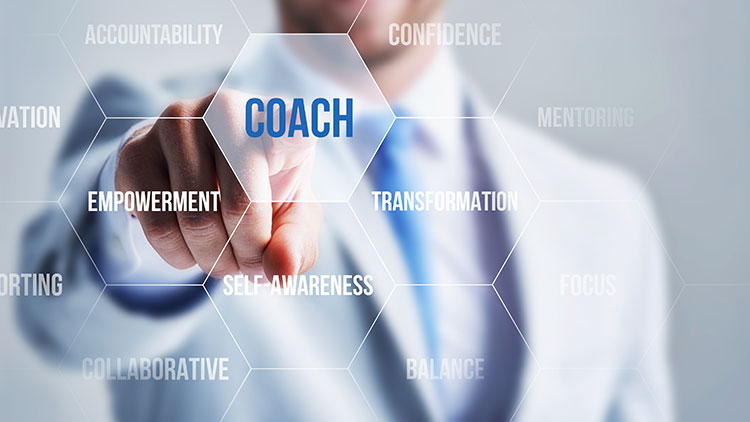
A collaborative relationship is established between a leader and a coach to bring about sustained behavioral change and improved performance. This is done in the following ways:
- Dedicated one-on-one sessions where the coach and the executive determine what levers are available to drive greater performance.
- Define what behaviors and thought processes aren’t conducive to producing the desired outcomes and which ones are.
- Individual sessions provide an unbiased sounding board between the advisor and coach, which aids the individual in identifying opportunities and pathways to success.
Assisting to find balance in their personal lives is a byproduct of these individual sessions. These sessions are conducted confidentially, in person or virtually, depending on distance and preference.
Coaching is an Investment
The investment is both short- and long-term, as seen when the client applies the new awareness across a variety of situations beyond coaching. In addition, if leading people, the client will transfer their coaching and leadership development to their relationship with their team so they also can develop from the application of the coaching principles. The organization as a whole gains from the energy and leadership modeled by the coach.
“I continue to retain, and refer Cain-Stanley
again-and-again…”

“Patti Cain-Stanley and her coaching staff have been trusted partners for my personal leadership advancement and for the up-leveling of dozens of members of my team for the past 10 years. I continue to retain and refer Cain-Stanley and Co. again-and-again, not just because they lift leaders up, but by deeply understanding and designing programs just for them.” Samantha Paxson, Former EVP/Chief Experience Officer, CO-OP Financial Services
Group Coaching and Facilitation
Group coaching creates a dynamic environment where individuals can grow together while working toward shared goals. At CSC, it is used as a strategic and cost-effective approach to strengthen learning, reinforce outcomes, and support meaningful progress across teams and organizations.

Group Coaching Draws from Real World Situations
In a group coaching session, the facilitator leads the group through concepts and common situations and draws out insights, questions, successes, and setbacks. In turn, individual participants share and learn from each other as well as the coach/facilitator. This highly effective and productive method of coaching provides support for individuals or teams working on, or through, similar business or developmental issues. A real sense of community is created that can be called upon for support inside or outside of the sessions.
Group Coaching Programs
Effective Leadership Team Dynamics
The key to strong decision-making is the ability to bring all necessary information to the table, to discuss and cull through the data, and make appropriate decisions based on the collective wisdom of the team. This requires an environment that allows for all relevant and important information and opinions to be voiced, questioned, and vetted. Without a trusting, safe atmosphere, this will not occur. We support leaders in creating the environment necessary for these critical interactions.
Our approach:
- Understand the desired team dynamics.
- Interview the team leader to understand his/her view of the existing dynamics and why they are occurring.
- Interview the team participants individually and collectively to understand their goals for the team and what they believe is in the way.
- Feedback to the team leader and/or to the team of the survey results and the written recommendations for creating a positive shift in the dynamic and team effectiveness.
- If engaged, post-assessment, facilitate meetings and coach team leader and/or individual leaders to achieve desired outcomes.
Senior Team Monthly Meeting Planning and Facilitation
Senior or Leadership Team meetings are critical to the success of any organization. Oftentimes the team and the meetings have not been successfully chartered—purpose of the team, does team=meeting (does the team exist outside of the meeting?), norms/values, roles/responsibilities, ownership and accountabilities, follow-up, etc. Without this work, the team might not have the clarity and direction necessary to operate effectively.
To this end, we work with leaders and their teams to understand their purpose and then to create the structure and understanding to allow the outcomes to be achieved. Once chartered, we can facilitate on-going Leadership Team meetings and/or work to create the capability in others.
Becoming an Expert Facilitator
Facilitation and meeting planning isn’t easy. It starts with chartering the team as well as the meeting, and then determining what outcomes are needed to achieve the meeting goals that in turn drive business effectiveness. Ongoing work is required to maintain the integrity of the meeting and to achieve the prescribed goals.
If you would like CSC’s support, below are some of our facilitated group coaching programs:
Planning is Essential
Preparation is necessary to create cogent conversations on a topic—context on the subject, purpose of discussion, desired outcomes, and associated documentation—all need to be prepared and distributed prior to the meeting. This level of preparation helps the leader clarify the topic and his/her thoughts to present to the group. Allowing the group the time to process the information in advance creates a more robust discussion.
Keep the Meeting on Track
Once in the meeting, effective facilitation is vital to keeping the meeting on track and delivering on its goals. Facilitation requires the individual leading the meeting to be highly vigilant in assuring that the meeting goals, personal agendas, topic discussion times, etc. are all in balance. This can be especially challenging for the leader to not get lost in the topic and lose sight of the facilitation.
Leadership Development Assessments
Listed below are the assessments that CSC offers. For additional information regarding a particular assessment, please inquire directly.
Click below for more details:
360° Assessments
- Korn Ferry Emotional Intelligence 360° Assessment—Emotional Intelligence, Leadership Styles, and Organizational Climate
- OSI Polaris Leadership Competency 360° Assessment
- CSC Interview 360° Assessment
- Excelerate Communication 360° Assessment
Enneagram Personality Profile
The Enneagram describes nine different sets of values and filters through which the world can be seen. It does not “put people in boxes.” Instead, it actually helps people learn to recognize and expand the boxes they are already in, and ultimately to dissolve those boxes.
It’s a respectful and dynamic system that provides a path of healthy development for each type, including how to build on strengths and avoid pitfalls. It assists leaders and employees in understanding themselves, clients, customers, others in the organization, and the organization itself through new eyes. Energy is freed for productivity and creativity that was previously lost in frustration and agitation.
Integration of the Enneagram allows teams and organizations to optimize individuals’ strengths, take advantage of synergy, improve teamwork, enhance mutual understanding and respect, improve leadership, enhance communication, and increase customer satisfaction, morale, productivity, and employee retention.
Learn More About the Enneagram Test.
Myers-Briggs Type Indicator® (MBTI®)
The purpose of the Myers-Briggs Type Indicator® (MBTI®) personality inventory is to make the theory of psychological types described by C. G. Jung understandable and useful in people’s lives. The essence of the theory is that much seemingly random variation in the behavior is actually quite orderly and consistent, being due to basic differences in the ways individuals prefer to use their perception and judgment. Through the MBTI®, 16 distinctive personality types can be identified based on the interactions among the preferences.
Excerpted from the MBTI® Manual: A Guide to the Development and Use of the Myers-Briggs Type Indicator®
Preferences:
- Favorite world: Do you prefer to focus on the outer world or on your own inner world? This is called Extraversion (E) or Introversion (I).
- Information: Do you prefer to focus on the basic information you take in or do you prefer to interpret and add meaning? This is called Sensing (S) or Intuition (N).
- Decisions: When making decisions, do you prefer to first look at logic and consistency or first look at the people and special circumstances? This is called Thinking (T) or Feeling (F).
- Structure: In dealing with the outside world, do you prefer to get things decided or do you prefer to stay open to new information and options? This is called Judging (J) or Perceiving (P).
Your Personality Type: When you decide on your preference in each category, you have determined your own personality type expressed in 4 letters, e.g., ENTJ, ISFP. All types are equal. A mixture of types is best for a work group or team because many points of view are represented.
https://www.myersbriggs.org/my-mbti-personality-type/mbti-basics/
DiSC Profile Personality Assessment
The DiSC personality report or inventory, developed by William Moulton Marston, profiles four primary behavioral styles, each with a very distinct and predictable pattern of observable behavior. Applied in corporate, business and personal situations, the DiSC inventory can lead to professional and personal insights. Understanding the DiSC patterns has empowered millions internationally to better understand themselves and others. The results of the online DiSC profile report are designed to provide targeted insights and strategies for interpersonal success through more effective communication, understanding and tolerance. DiSC is used for personal growth and development, training, coaching and managing of individuals, groups, teams, and organizations. It helps people explore behavior across four primary dimensions:
Dominance: Direct and to the point, decisive and bottom-line-oriented. These people tend to be independent and results driven. They are strong-willed people who enjoy challenges, taking action, and immediate results.
Influence: Optimistic and Outgoing. Often highly social and outgoing. They prefer participating on teams, sharing thoughts, and entertaining and energizing others.
Steadiness: Empathetic & Cooperative. Typically team players and are supportive and helpful to others. They prefer being behind the scene, working in consistent and predictable ways. They are often good listeners and avoid change and conflict
Conscientiousness: Concerned, Cautious & Correct. These individuals are often focused on details and quality. They plan ahead; constantly check for accuracy, and what to know “how” and “why”.
Thomas-Kilmann Conflict Mode Instrument (TKI)
Because no two individuals have exactly the same expectations and desires, conflict is a natural part of our interactions with others. The Thomas-Kilmann Conflict Mode Instrument (TKI) is designed to measure a person’s behavior in conflict situations. “Conflict situations” are those in which the concerns of two people appear to be incompatible. In such situations, we can describe an individual’s behavior along two dimensions: (1) assertiveness, the extent to which the person attempts to satisfy his own concerns, and (2) cooperativeness, the extent to which the person attempts to satisfy the other person’s concerns. Through effective communication, emotional mastery, self-awareness and verbal and nonverbal communication skills, conflict can be navigated more effectively. Managing conflict isn’t always about resolving an issue; it’s about creating healthy environments that enable engagement and productivity. The TKI is a self-scoring assessment that takes about fifteen minutes to complete. Interpretation and feedback materials help you learn about the most appropriate uses for each conflict-handling mode.
Programs and Workshops
CSC offers many 2-4 hour workshops that are designed to jumpstart a team’s understanding of leadership. Each of the programs can be personalized or delivered off-the-shelf for greater cost effectiveness.
Off-the-Shelf Workshop (10% Personalization)
- Personalization includes slight or minimal modification of material to connect with audience—approximately 10%.
- 15-20 minute up-front telephone session with organization to understand goals of the workshop.
- 15-minute session debrief, if desired, to discuss workshop leader’s takeaways and potential next steps for the participants.
- 8-25 participants; additional leaders are necessary over 25 participants in order to effectively lead small group activities to support learning.
- 2-4 hours
Personalized Workshop
- Workshop is personalized to organization’s specifications.
- 1-hour upfront meeting to understand organizational context (including possible participant interviews) and desired outcomes.
- Material selected and workshop designed solely for use in organization.
- 15-minute session debrief, to discuss workshop leader’s takeaways and potential next steps for the participants.
- 8-25 participants; additional leaders are necessary over 25 participants in order to effectively lead small group activities to support learning.
- 2-4 hours
Workshops and Associated Takeaways
Click below for more details:
Leadership and Management: What distinguishes a leader from a manager and how do you effectively do both?
-
- Differences between a manager and a leader; why you need to be both
- Why extraordinary leaders get infinitely better results than good leaders or managers alone
- Understanding and applying keys to leadership success
Leadership: Building a Culture of Accountability
- How Leaders Impact Culture
- What is your Leadership Style, and how can you Capitalize on it?
- How to Instill Ownership without Losing Control
- Making Accountability a Natural part of a Positive and Collaborative Environment
- Summary and Application
Leadership Styles: What are your go-to styles and how can you flex your approach based on the situational requirements?
- Introduction to the six styles of leadership
- What is your go-to style(s)?
- When is that style(s) most effective; understanding if another style might be better?
- Practicing flexing your style to the situation